
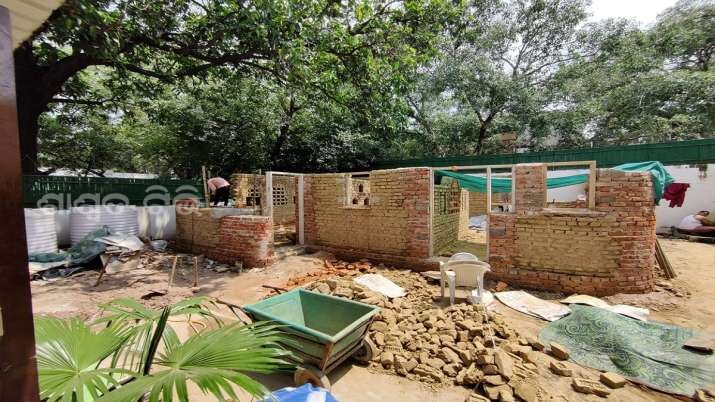
Baleswar MP Stays Rooted in Culture, Builds Clay Hut in Delhi Government Quarters
Nilgiri, 15/02 – Pratap Chandra Sarangi, Member of Parliament from Baleswar and former Union Minister, remains a widely-discussed figure in Indian politics—not just for his political stance but for his simple lifestyle. Once again, he has become the center of attention for staying true to his roots. Previously, his modest residence and austere way of life had made national headlines. Now, he is in the spotlight once again for building a traditional clay and thatch hut within the premises of his official government residence in Delhi.
To provide context, Pratap Sarangi rose to prominence in the BJP from a thatched house in Gopinathpur, Baleswar district. Before entering mainstream politics, he worked as a clerk at Nilgiri College and was actively involved with organizations like VHP, Bajrang Dal, Durga Vahini, and anti-liquor movements, where he demonstrated his unwavering dedication to the cause of Bharat Mata (Mother India).
He entered electoral politics in 2004 and won an assembly seat on a BJP ticket. He repeated his victory in 2009. Later, the party nominated him for the Baleswar Lok Sabha seat. Although he initially lost, his deep connection with the grassroots and trust from Prime Minister Modi led to his renomination in 2019, which he won.
His unpretentious lifestyle and alignment with PM Modi’s vision of clean and transparent governance earned him massive local support. The public of Baleswar crowned him with electoral victory. Despite his position, he never abandoned his minimalist lifestyle—using neem twigs for brushing, bathing in tubewell water or ponds, sweeping temple premises before offering prayers, and sitting under thatched roofs to eat.
His lifestyle wasn’t just symbolic. He personally funded education for tribal children and taught them himself. Helping kids learn how to ride bicycles was one of his fond habits. These gestures received widespread media attention, and even Prime Minister Modi recognized his dedication by appointing him to a key ministerial position.
Despite the elevation in political status, Sarangi remained unchanged. Dignitaries such as Shankaracharyas, Governors, Union Ministers, and Central officials have visited his residence and expressed astonishment at his simplicity and cultural integrity.
His choice to build a mud hut in the heart of Delhi’s official quarters is just another testament to a life lived by example—grounded in values, culture, and service.