
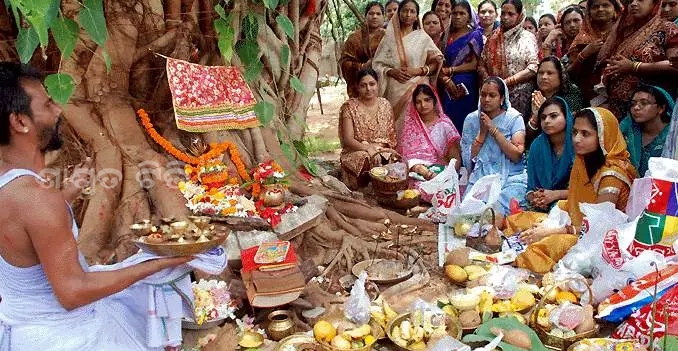
Savitri Brata – A Sacred Fast Observed by Married Odia Women
Savitri Brata is one of the most important and sacred fasts observed by married Odia women. It is performed annually on the Amavasya (new moon) day of the Hindu month of Jyestha. On this day, married women observe this fast and ritual with devotion, praying for the long life and well-being of their husbands.
On the day of the brata, women complete their daily morning chores, wear new clothes, and visit the temple of Goddess Savitri. They offer items such as saree, bangles, alta (a red dye), sindoor (vermillion), and food to the goddess, and pray for the prosperity and longevity of their husbands. The women also recite the Savitri Katha (story of Savitri). The presiding deity of this puja is Goddess Savitri, who is known as the consort of Lord Brahma, and is associated with the divine energy Gayatri and the Sun God.
The story of the Savitri Brata centers around how the deep devotion and determination of Goddess Savitri brought her husband Satyavan back from the clutches of death. According to legend, King Ashwapati, longing for a daughter, conducted a yagna to appease the gods. At the conclusion of the ritual, Goddess Savitri appeared and asked the king to request a boon. As he had no children, the king pleaded for a son. The goddess, however, informed him that a son was not destined for him, but instead blessed him with an extraordinary daughter.
Eventually, a beautiful daughter was born to Queen Malavi, the wife of King Ashwapati, and she was named Savitri. As Savitri reached maturity, she embarked on a journey with her companions, with her father’s permission, to find a suitable husband of her own choice. During her travels, she came across Satyavan, the son of King Dyumatsena of Shalwa Desh, who was born to Queen Shaibya. Due to a divine misfortune, King Dyumatsena had lost his eyesight and his kingdom, and had taken to forest life with his family. Satyavan lived a simple and devotional life in the forest, serving his blind parents with utmost dedication.
Savitri was deeply moved by Satyavan’s devotion and righteousness and decided to marry him. On returning home, she informed her father of her decision. At that time, Sage Narada, who was present, revealed that Satyavan had only one year left to live, and urged her to reconsider. However, Savitri remained steadfast and refused to change her decision. She married Satyavan and chose to live in the forest, dedicating herself to serving her in-laws and leading a simple life.
Three days before the completion of one year of marriage, Savitri began a three-night fast (Triratra Brata). On the day marking one year, she accompanied Satyavan into the forest to gather fruits and firewood. While in the forest, Satyavan felt unwell, rested his head on Savitri’s lap, and passed away peacefully — this was the foretold death.
Holding her husband in her lap, Savitri remained by his side in the forest. When the messengers of Yama, the God of Death, came to take Satyavan’s soul, they were unable to do so due to Savitri’s unwavering devotion. Eventually, Yama himself appeared and took Satyavan’s soul. Savitri began to follow Yama, and impressed by her devotion, commitment, and eloquent praise, Yama offered her three boons, on the condition that she not ask for Satyavan’s life directly.
As her first boon, Savitri asked for the restoration of her father-in-law’s eyesight and lost kingdom. As her second, she asked for a son for her own father. As the third, she wished for a hundred sons from her own womb. As Yama granted the third boon and prepared to depart, Savitri cleverly questioned how she could bear sons without her husband. Left with no alternative, Yama had to restore Satyavan’s life and bless him with long life.
Since then, Savitri Brata has been observed with deep devotion and reverence by married Odia women, who follow the rituals with sincerity and prayer, seeking the well-being and longevity of their husbands.