
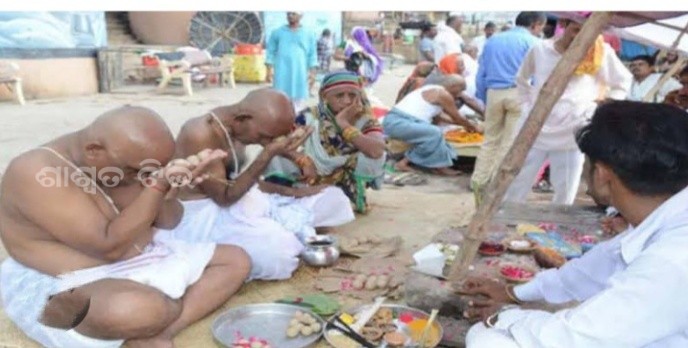
Heirs Perform Pinda Dana at Vishwamitra Math Ghat in Honor of Ancestors
Kakatpur, 14/10 — The first fortnight of the Ashwina month is traditionally known as Pitru Paksha, dedicated to honoring ancestors. The new moon day of this fortnight is observed as Mahalaya Amavasya. As offerings and sacrifices are made in memory of the departed souls during this time, the period is also referred to as Pitru Parva.
In this context, at the Vishwamitra Math Ghat in Kakatpur, Puri district, descendants performed the rituals of pinda dana and immersed the ashes of their ancestors as part of the observance. Pitru Paksha lasts for fifteen days, from the first day (Pratipada) to the new moon day (Amavasya) of the Krishna Paksha of Ashwina month. After performing tarpana until Chaturdashi, the pinda dana ritual is performed on Amavasya.
The Amavasya that falls when the sun is in the Virgo zodiac sign is known as Mahalaya Amavasya. During Mahalaya Shraddha, in the tarpana offering ritual, homage is paid once to twenty divine entities including Brahma, Vishnu, Rudra, Prajapati, Acharya, the Vedas, Chhandas, Gandharvas, Devas, ancient teachers, Samvatsara (cosmic year), celestial beings, Nagas, Yakshas, Bhutas, Pisachas, plants, herbs, elemental spirits, and the Earth itself. Additionally, twice to the seven sages — Sanat, Sananda, Sanatana, Kapila, Asuri, Dovu, and Panchashikha — and thrice to the paternal ancestors (pitru purushas), offering them symbolic food and water as a mark of reverence.
In Pitru Tarpana, the father is envisioned as Rudra, the grandfather as Vasu, and the great-grandfather as Aditya. Since the presence of all deities, sages, and ancestral spirits is invoked in the ritual, the ceremony is called Mahalaya Shraddha.
From the Pratipada to the Amavasya of the Krishna Paksha in the Bhadrapada month, any one of these fifteen days may be chosen to perform Shraddha. Hence, this entire period is called Pitru Paksha. Among all the Shraddha rituals observed in the Hindu religious tradition for ancestors, Mahalaya Shraddha is considered the most sacred and significant. During this time, offerings of food are made to Brahmins and the poor according to one’s capacity, which is believed to bring blessings, merit, and the upliftment of future generations.
According to legend, the great donor Karna, renowned for his generosity, received gold and silver in Yamaloka (the land of the dead), but no food. It was because, while alive, he had never donated food. He prayed to Yamaraj (the god of death) and was allowed to return to Earth for fourteen days, during which he gave anna daan (food donation) to Brahmins and the needy. After returning to Yamaloka, he was no longer deprived of food. The fourteen days Karna spent on Earth donating food are believed to be the origin of Pitru Paksha.