
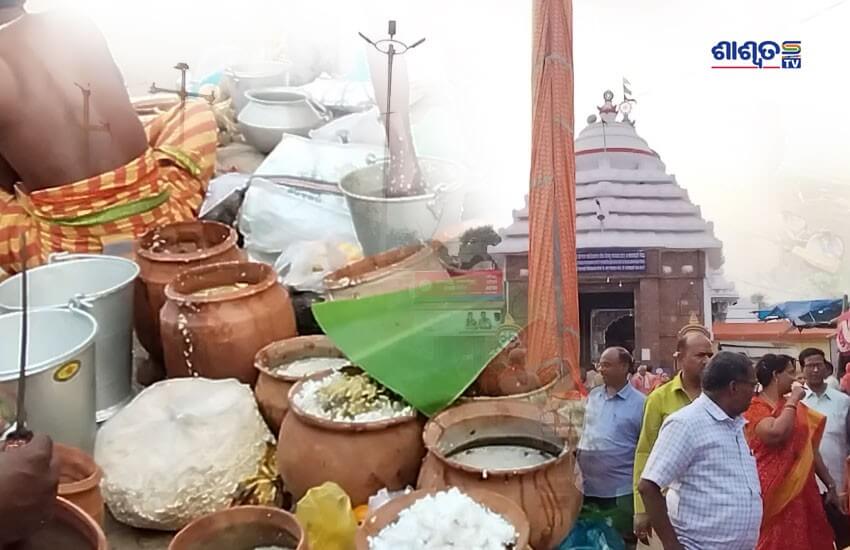
Rice Offering Made Once a Year at Sakhigopal Temple
Satyabadi | Date: 15-01-2024
The holy land of Bharat is vibrant with celebration on the auspicious occasion of Makar Sankranti. This festival is observed across various parts of India under different names. In eastern India, it is widely celebrated as Makar Sankranti. On this occasion, the Sakshigopal Temple too becomes festive and lively.
According to tradition, on the eve of Makar Sankranti, Goddess Mahalaxmi returns to the temple from her paternal home bearing the Makar Bhara (sacred offerings). As per long-standing customs, every year at the end of the month, the sacred offerings are brought from the house of Debaraj Sahu of Basantapur village, located in Dasbidyadharpur Panchayat. The offerings are carried in two baskets (olias) containing new raw rice (arua), coconut, ripe bananas, Dhanu mua (sweet puffed rice), flower garlands, and new clothes meant for the deity.
These are ceremonially brought near the temple by the Makar Bhara procession, accompanied by traditional music instruments like chhati-trasa, ghanta, baja, mahuri, baje kahali, and flaming torches (chhamu mashal). The servitors then escort the young girl (kuniya) carrying the offerings to the temple.
As soon as Mahalaxmi’s Bhara enters the temple, the Kshira Utthura ritual begins at the Guapahacha (inner sanctum). Inside the sanctum and around the temple, a triple-circle (ghera) and a six-circle ritual around the boundary are performed as part of the Nabanka Bedha Niti (circular circumambulation ritual).
Sakhigopal, who does not receive rice offerings throughout the rest of the year, is specially offered the Makar Chaula (a traditional rice preparation) only once a year on this day during the Makar Bhara ritual.