
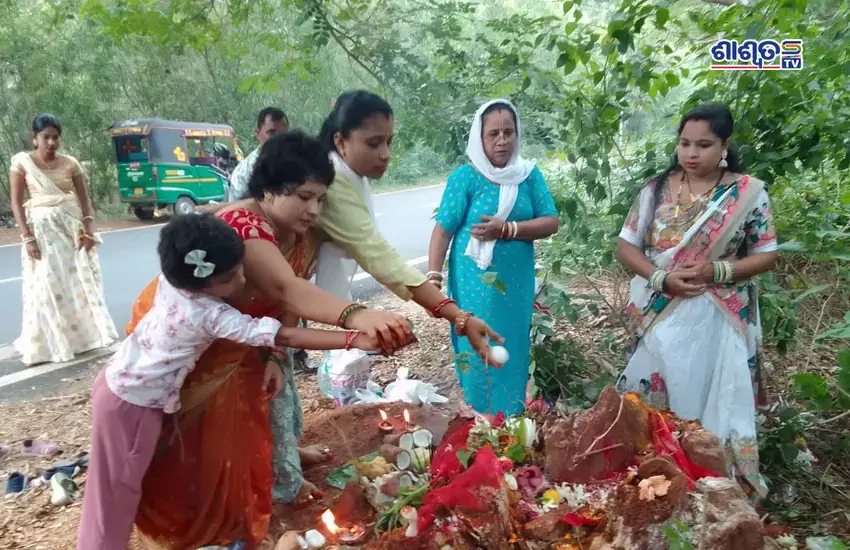
Nagula Chaturthi Puja Performed to Ward Off Snake Bites
Puri: 05.11.2024
On the occasion of Nagula Chaturthi, Telugu community women in Puri performed traditional rituals with devotion and enthusiasm. This puja is held on Kartika Shukla Chaturthi (the fourth day of the waxing phase of the Kartika month) in honor of the serpent deity (Nag Devta). Women observe this ritual praying for the well-being and prosperity of their families and children. There is a strong popular belief that performing this puja protects one from the fear of snake bites.
The central ritual of this puja is called Hunkar Puja. Women gather at a designated spot called “Hunkar” or bring a portion of the hunkar home and place it near the base of a tulsi plant or a sacred courtyard. They install symbolic idols of Nag and Nagin (male and female serpents), decorate the area with flowers, prepare offerings, and worship with lamps, incense, and food items (naivedya). In some regions, idols of Nag and Nagin are crafted out of flour and worshipped.
A unique aspect of the Telugu community’s practice is that they offer eggs during this ritual at the Hunkar spot.
Snake worship in India is not limited to religious sentiments alone; it also holds significance in Indian art and architecture. In many ancient temples, one can see the main entrances adorned with snake motifs, especially the Nagabandha (coiled snake patterns), which are considered highly auspicious according to Vastu Shastra (traditional Indian architecture). Even today, the placement and orientation of houses are often decided after considering Naga Nadi (a traditional astrological principle related to serpents).
Thus, Nag Chaturthi or Nagula Chaturthi is an expression of serpent worship—an age-old cultural and spiritual practice in India. It continues to influence and enrich our religious and cultural traditions. Women observe this festival with deep faith, praying for the welfare and prosperity of their families and offspring.