
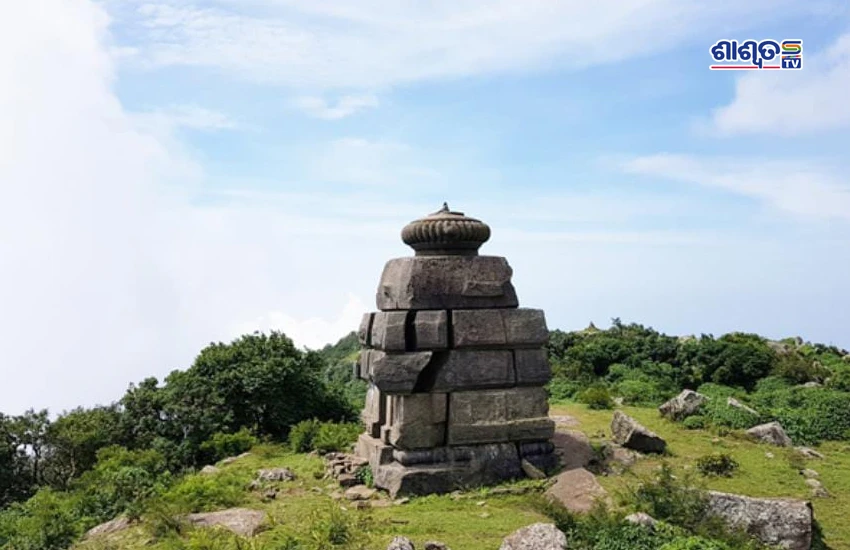
Here Lies Odisha’s Highest Shaiva Shrine – The Temple of Baba Gokarneshwar
Gajapati: Dated 18.6.24 (Shashwat TV) – Singhari Alok Khuntia – Among the seven sacred mountains of India, Mahendragiri is one of the most revered. Located in Paralakhemundi, the sub-division headquarters of Gajapati district in Odisha, Mahendragiri stands as the highest mountain in the state, rising 4,997 feet above sea level. Geographically, the hilly terrain between the Mahanadi and Godavari rivers is famously known as the “Mahendra region.”
Three ancient Shaiva temples are situated on this mountain. During the reign of the Ganga dynasty in Kalinganagar, the temples of Gokarneshwar (also known as Kunti temple) and Yudhishthira temple were built. It is believed that the Bhima temple was constructed even earlier, around the 4th century. However, as per the Puranas, the Gokarneshwar temple along with the other two temples were already established, and the Gokarneshwar temple is considered the highest temple in Odisha.
The Pandavas are said to have stayed on Mahendragiri for several years during their exile, and in memory of them, the temples were named after Bhima, Yudhishthira, and Kunti. Earlier, pilgrims had to trek 8 to 10 kilometers on foot to reach Mahendragiri, but since March 2021, the road constructed by the Government of India was completed and opened to the public. Now, visitors can reach near Yudhishthira’s temple by vehicle in just 15–25 minutes.
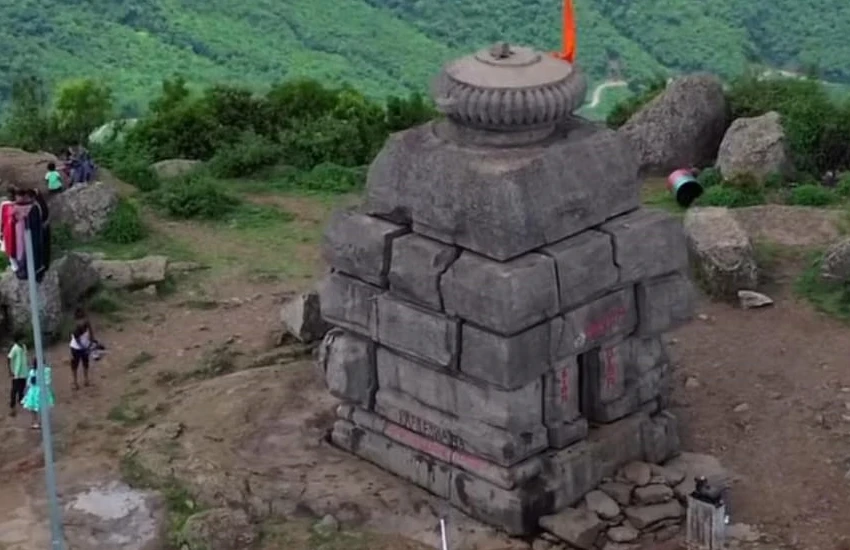
According to a mythological tale, Arjuna, while hunting deer for performing the ancestral rites (Pitru Shraddha) on Mahendragiri, accidentally shot and killed a blue cow (Neelagai) with an arrow. One of its ears fell off at the spot where a Shiva Linga named Gokarneshwar was later consecrated. As per a story in the Vishnu Purana, when Lord Vishnu killed the demon Gayasura, the latter asked for a boon that after his death, his body would remain spread across the Earth. Accordingly, his head fell in present-day Gaya in Bihar, his navel at Jajpur in Odisha, and his feet touched Mahendragiri.
As per Vishnu’s boon, performing Pind Daan (ancestral offerings) at these three locations—Gaya, Jajpur, and Mahendragiri—brings great spiritual merit and satisfaction to the ancestors. Since then, Mahendragiri has earned fame as Padagaya (Gaya of the feet).
Every year, on the eve of Maha Shivaratri, hundreds of thousands of devotees gather at Mahendragiri. They offer Shraddha to their ancestors and have darshan of Baba Gokarneshwar, gaining immense spiritual fulfillment. Apart from this, the natural beauty and cool breeze of Mahendragiri captivate the visitors. The view of the eastern sea from Mahendragiri is stunning, and even more mesmerizing is the sunrise. As the sun rises from the sea’s horizon, it appears like a crimson globe illuminating the Earth — a magical sight that leaves onlookers spellbound.
People of all castes, religions, and communities gather here in unity. Keeping the crowds in mind, the district administration has been managing the Maha Shivaratri pilgrimage in an organized way since 1990. A paved road to the Mahendra peak has already been completed. This year, a massive crowd is expected for Shivaratri, and the Gajapati district administration has made extensive arrangements including security, drinking water, lighting, and other essential facilities.